I publish a monthly email newsletter with personal updates and interesting things I read or learned that month. The latter is archived below. If you’d like to be added to the newsletter, email me.
December 2025 Roundup
School cellphone bans likely have a small, positive impact on test performance
A recent difference in difference study finds Florida's 2023 secondary school
cell phone ban increased test scores by 0.6 percentiles; a smaller effect than I
expected.
The Impact of Cellphone Bans in Schools on Student Outcomes: Evidence from Florida, National Bureau of Economic Research
The Impact of Cellphone Bans in Schools on Student Outcomes: Evidence from Florida, National Bureau of Economic Research
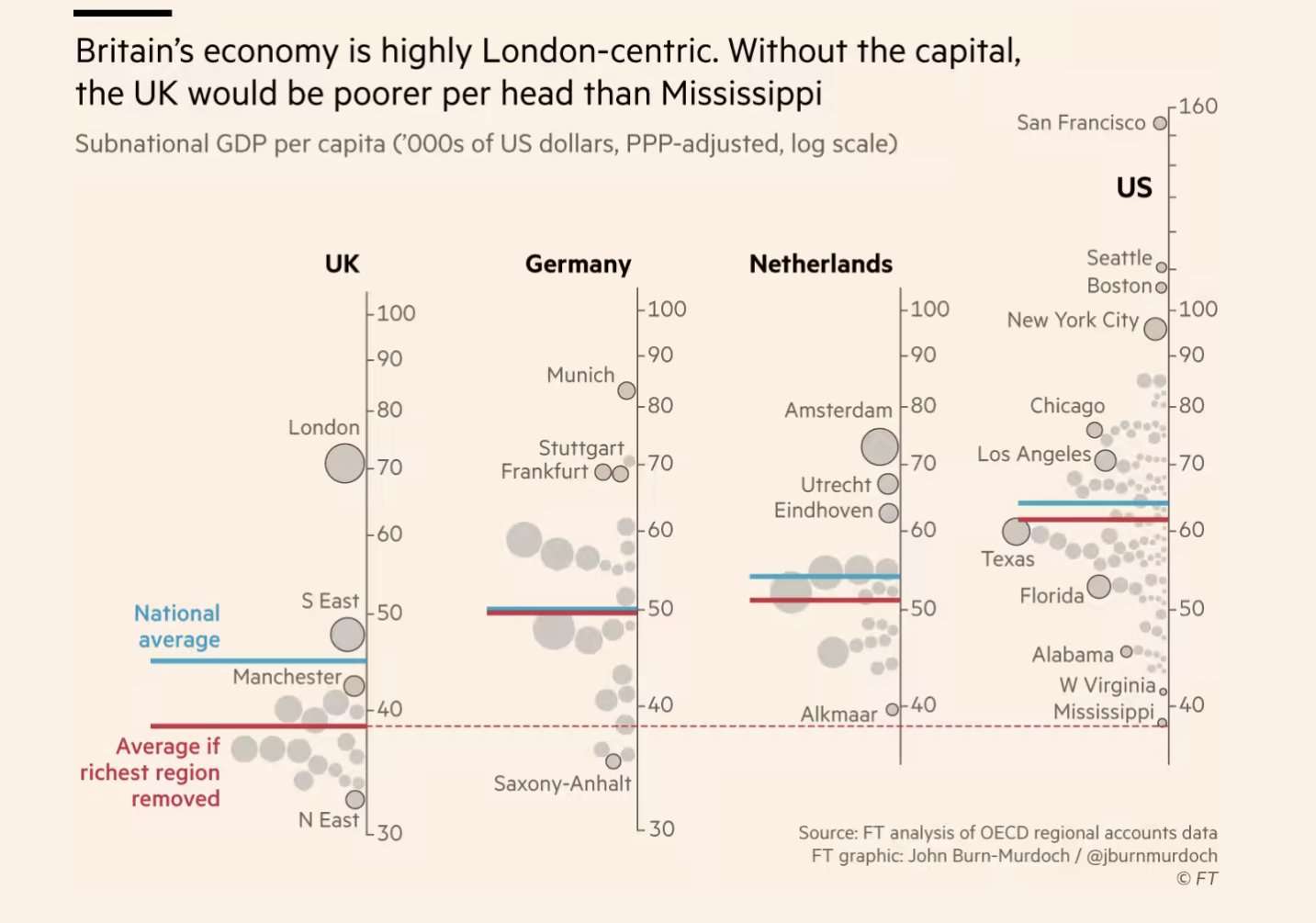
The UK without London is poorer than Mississippi
Tyler Cowen's alternative to Fischer Random Chess
In his conversation with Kenneth Rogoff, Tyler Cowen suggests an alternative to
Fischer Random Chess: select starting positions from a database of equal
positions 2 or 4 moves in. In Fischer Random, the back rank is randomized
emphasizing over-the-board play over preparation. Cowen's alternative achieves
the same goal, but results in more standard positions which observers can
empathize with. An interesting idea I hadn't heard before.
Kenneth Rogoff on Monetary Moves, Fiscal Gambits, and Classical Chess (Ep. 241) , Conversations with Tyler
Kenneth Rogoff on Monetary Moves, Fiscal Gambits, and Classical Chess (Ep. 241) , Conversations with Tyler
St. Petersburg Paradox
I was given How Not to Be Wrong for Christmas and am enjoying it so far.
I've watched plenty of Numberphile and Veritasium and have read Stephen Pinker's
similar book, Rationality, yet it introduces many topics I haven't come
across before. One of which is
St. Petersburg paradox:
How Not to Be Wrong, Jordan Ellenberg
- I put $2 in a pot then flip a coin
- If tails, the game ends and you win the money. If heads, I double the money
- I flip the coin again. Repeat step 2
How Not to Be Wrong, Jordan Ellenberg
I like how Casey Handmer and Terraform think about resumes
I could look at two identical candidates with similar career paths, and have no way of knowing that one of them built a jet engine in their living room. Their resumes are very similar and have no ability to choose between them. But a single photo of them in front of their own jet engine would tell me 95% of what I need to know to make a job offer. It would pretty much instantly put them on the top of the screening pile too
For Terraform, send us your one pagers. Ideally they will contain photos of awesome hardware you personally created, together with a brief and informative summary of how the project relates to your desired role with us
Maximizing Resume SNR, Casey Handmer
An argument to emphasize culture over process and incentives in software engineering teams
Culture matters, Dan Luu
Gregory Clark's The Son Also Rises gets repetitive but is worth the read.
Clark's central insight is that if you track the prevalence of a surname in an
elite institution, it remains over- or under-represented much longer than
traditional social mobility rates would suggest. The majority of the book is
spent showing this holds regardless of time-period or location.
To explain this, Clark models status as latent variable. This variable is "indistinguishable" from genetics, depending only on that of the parents and randomness. The variable determines, again with random noise, observable outcomes like income or educational attainment. Traditional methods measure observable variables regressing to the mean, and therefore overestimate the pace of social mobility.
Clark concludes that status is mostly inherited, government efforts to increase social mobility have largely failed and as long as marriage is assortative (high-status people marry other high-status people) social mobility will remain slow.
The Son Also Rises, Gregory Clark
To explain this, Clark models status as latent variable. This variable is "indistinguishable" from genetics, depending only on that of the parents and randomness. The variable determines, again with random noise, observable outcomes like income or educational attainment. Traditional methods measure observable variables regressing to the mean, and therefore overestimate the pace of social mobility.
Clark concludes that status is mostly inherited, government efforts to increase social mobility have largely failed and as long as marriage is assortative (high-status people marry other high-status people) social mobility will remain slow.
The Son Also Rises, Gregory Clark
Bryan Caplan's The Case Against Education argues higher-ed is mostly signaling.
When we look at countries around the world, a year of education appears to raise an individual’s income by 8 to 11 percent. By contrast, increasing education across a country’s population by an average of one year per person raises the national income by only 1 to 3 percent. In other words, education enriches individuals much more than it enriches nations.
Correcting for underlying cognitive ability, Caplan estimates 60% or more of the education-wage premium is the sheepskin effect. In particular, he argues education signals intelligence, conscientiousness, and conformity. Firms pay this premium, so an open question on my mind is why probationary periods aren't more common.
The Case Against Education, Bryan Caplan
The World Might be Better off Without College for Everyone, Bryan Caplan